Everything You Need to Know Before You Visit a Cenote
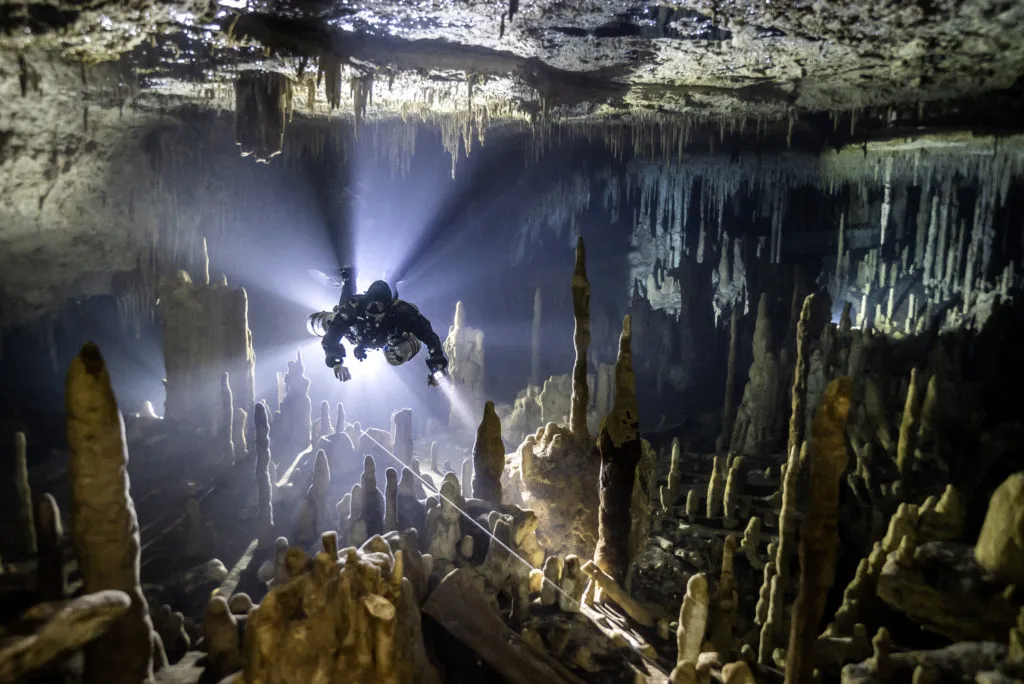
Cover picture credits: SJ Alice Bennett/Proyecto Mayakoba
Few natural wonders are as deeply connected to the Yucatán Peninsula as cenotes. These freshwater sinkholes have sustained life for thousands of years and played a central role in Maya culture, spirituality, and daily life, inspiring stories and traditions that continue to shape how the region sees itself.
Beneath the peninsula lies a vast network of cenotes, caves, and underground rivers, once regarded by the Maya as sacred places and still among the most fascinating features of the landscape today. At Mayakoba, guests can discover this hidden world through guided visits to the resort’s own cenote, El Burródromo, encounter them during their play at El Cmaleón Golf Course, or venture further with Mayakoba Experiences to explore other cenotes throughout the Riviera Maya.
Understanding a bit about their history, ecology, and cultural significance adds a deeper layer to the experience, so here’s everything worth knowing before you go.
What Is A Cenote?
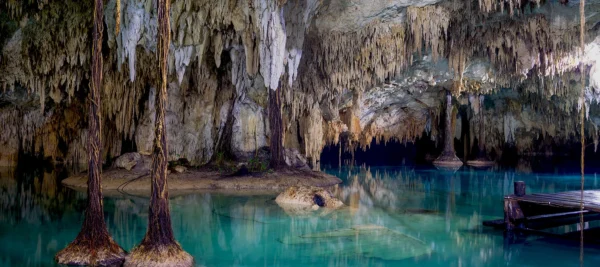
A cenote is a natural opening that provides access to an underground freshwater system. Over thousands of years, rainwater gradually dissolved the limestone bedrock that forms the Yucatán Peninsula, carving out an extensive network of caves, rivers, and caverns beneath the surface.
The region is home to thousands of cenotes, each with its own character. Some open straight to the sky, while others stay hidden within caves, lit only by whatever light filters in through small openings in the rock. Together, they form part of one of the largest underground freshwater systems in the world, and they continue to play an essential role in the region’s ecological health, supporting unique ecosystems and specialized wildlife found nowhere else.
Why Were Cenotes Important to the Maya?
For the ancient Maya, cenotes were essential sources of fresh water and held deep spiritual meaning. They were places of ceremony and mythology, seen as doorways between the earthly world and the world of the spirits, and treated with the kind of respect that travelers today are wise to carry with them too.
That dual role, as both practical resource and sacred space, is part of what makes cenotes so compelling to visit. They offer a window into the region’s geological history and its cultural heritage at the same time.
What Animals Live in a Cenote?
One of the most fascinating parts of visiting a cenote is discovering what lives underground. Inside El Burródromo, guests may spot the blind cave fish, a small, pale species that has evolved without functional eyes after generations spent in total darkness.
Hundreds of bats also call the cavern home, often in every stage of life at once. During certain times of the year, young bats and even newborns can be seen tucked into the most protected corners of the cave, away from the entrance and any light. These animals are a reminder that a cenote isn’t just a beautiful space to look at, it’s a living ecosystem, and guides keep groups at a respectful distance to make sure it stays that way.
Photo credit: James Batt, for the book “Birds of Mayakoba”
The Legend of the Toh Bird
Step back outside, and there’s a good chance you’ll spot one of the most distinctive birds of the Yucatán Peninsula: the Toh. Known for its turquoise and rust-colored plumage and its long tail feathers that swing gently like a pendulum, the bird has earned the nickname “pájaro reloj,” or clock bird, and is closely associated with caves and cenotes throughout the region.
According to Maya legend, the Toh was once so absorbed in admiring its own beauty that it stopped helping the other birds prepare for an approaching storm. When the storm hit and lasted for days, the Toh went hungry while the others, who had stored food together, did not. The lesson it carries since then is simple: beauty alone doesn’t sustain anyone, but community does. Today, the Toh is often seen perched near cenote entrances, watching quietly before deciding whether it’s worth being seen at all.
El Burródromo: Mayakoba’s Cenote in the Riviera Maya
By reserving the experience with each hotel’s concierge, Mayakoba guests have the opportunity to visit El Burródromo, a cave-type cenote that offers a glimpse into one of the Yucatán Peninsula’s most fascinating ecosystems. The visit is guided, and along the way, guests learn about the role cenotes played in Maya cosmovision, the importance of these freshwater systems throughout the region, and how this particular cave sustains the life within it.
El Burródromo remains largely untouched. Human intervention has been kept to a minimum, limited to a stairway and lighting that make the descent safe without disrupting the cave’s natural processes. As guests make their way down, they enter a space shaped by darkness, humidity, and geological forces that have been at work for thousands of years, a world that has evolved largely undisturbed and feels like nothing else above ground.
The Cenotes of Mayakoba: A Conservation Story
El Burródromo also holds a special place in the destination’s conservation story. It served as one of the entry points for The Cenotes of Mayakoba, an exploration and conservation project led by Mayakoba resident Matt Scantland.
Through exploration, the project documented extensive cave systems beneath the destination, contributing valuable knowledge about one of the region’s most important natural resources. The discoveries were captured in both a book and a short documentary film, and guests staying in select suites throughout Mayakoba may find the book among the in-room collection, a nice way to learn more about the exploration and conservation work behind it.
The project continues to highlight the importance of protecting these fragile ecosystems and deepening our understanding of the freshwater systems that lie beneath the Yucatán Peninsula. It’s a quiet reminder that what makes Mayakoba’s landscape remarkable often lies just beneath the surface.
Cenote Accessibility: What to Know Before You Go
Although accessibility is a priority in the Mayakoba community, the cenote experience at Mayakoba is best suited for guests with good mobility. Access requires descending a series of steep stairways inspired by traditional Maya designs, and the steps are uneven by modern standards.
The cave itself is naturally dark and humid, and for first-time visitors, that darkness can feel surprising at first. The eyes adapt quickly, though, and within moments most guests are settled in and taking in the beauty of the cavern.
Other Cenotes to Swim and Dive in the Riviera Maya
El Burródromo is a walking experience, but it’s far from the only way to encounter a cenote during a stay at Mayakoba. Across the Riviera Maya, many cenotes open into pools and underground rivers where swimming is possible, and some offer the kind of visibility that draws certified divers from around the world.
Through Mayakoba Experiences, guests can look into these options with the help of their concierge or the Mayakoba Experiences team, who can recommend cenotes suited to different interests, whether that means a swim in cool, crystalline water or a dive into one of the region’s underground cave systems.
What to Bring for a Cenote Visit
A few simple things can make the visit more enjoyable: comfortable footwear with good traction, lightweight clothing suited to warm and humid conditions, and a camera, when permitted, to capture the experience. Sunscreen is not recommended, since it can contaminate the water and the ecosystem. But most of all, bring some curiosity, since cenotes reveal themselves gradually, through small details, unexpected wildlife, and stories that have been passed down for generations.
Discover the Cenotes of the Riviera Maya at Mayakoba
Beyond its beaches, lagoons, golf courses, and culinary experiences, Mayakoba offers a chance to connect with the natural and cultural heritage of the Riviera Maya. A visit to the cenote is an invitation into a hidden world beneath the forest floor, where geology, biodiversity, exploration, and Maya history all come together in a single experience.
Reserve your stay at Mayakoba.com and discover El Burródromo, the destination’s most extraordinary natural treasure.
Looking for more adventures in Mayakoba? Check these out:
Select Co-Ownership Residences Now Offering a 20% Price Reduction
Privacy Notice
August 1st, 2016
Subject to the provided by the Federal Law on Protection of Personal Data Held by Third Parties, we inform you the following:
PARTY LIABLE FOR PERSONAL DATA.
“RLH Properties, S.A.B. de C.V.” (hereinafter named “RLH PROPERTIES”) with address at Av. Paseo de la Reforma 412, Piso 21, Colonia Juárez, Delegación Cuauhtémoc, C.P. 06600, Ciudad de México, shall hold on its own behalf or through any legal entity which is a holding company or branch office thereof with the conviction to protect personal information (hereinafter “Personal Data”) provided by the individuals (hereinafter “User”) and shall be liable for its Handling whenever obtained by the internet web site www.rlhproperties.mx (hereinafter the “Web Site”), by written means and/or by phone (hereinafter “Other Means”).
HANDLING PURPOSE.
RLH PROPERTIES may request and/or obtain Personal Data from User through the Web Site and Other Means for the purposes stated below; also to comply with any required legal provisions, or whenever requested by the competent authorities (hereinafter the “Handling”). In accordance to the applicable legal provisions in the United Mexican States (hereinafter “México”), RLH PROPERTIES and/or any third party who may intervene in any stage of the Handling of Personal Data shall maintain confidentiality regarding any data with such capacity.
Upon access and/or log in to the Web Site, Personal Data provided by User shall have the purpose of (i) identification; (ii) location; (iii) communication; (iv) contact; (v) sending information; (vi) statistical purposes; (vii) review and attend comments; (viii) extend the invitation to participate on RLH PROPERTIES’ social media; (ix) publicity; (x) fulfill effective laws; (xi) analyze and answer employment applications; (xii) send notices regarding amendments to changes of this Privacy Notice.
PERSONAL DATA REQUESTED
The Personal Data requested from User shall be:
Name
Electronic mail
Telephone
Unless User provides its Personal Data, services may not be accessed, however User may have access to other Services which do not require mandatory disclosure of Personal Data.
CONSENT.
In accordance to this Privacy Notice, access and/or log in through the Web Site and/or other means implies User’s full and unreserved consent for the Handling of Personal Data.
MEANS TO LIMIT THE USE OR DISCLOSURE OF PERSONAL DATA.
RLH PROPERTIES has physical, technical and administrative security means for the protection of Personal Data provided by User. Notwithstanding the provided in the Consent section, RLH PROPERTIES shall take all actions, measures and special steps as deemed necessary to maintain the right of protection of Personal Data for minors and legally disabled.
In the event you no longer wish to receive promotional messages by electronic mail and/or printed and/or telephone calls from RLH PROPERTIES, you may send your request to: info@rlhproperties.com.mx
WEBSITE EXCLUSION OF LIABILITY.
The Web Site may contain links, banners, buttons and/or search tools on the World Wide Net and, whenever used by User, may transfer to other internet sites owned by third parties. User’s Personal Data granted to such internet sites are not covered by this Privacy Notice and Handling shall not be liability of RLH PROPERTIES. User’s verification of the Privacy Notice of such internet sites is hereby recommended.
User may find within the Web Site, pages, promotional adds, microsites, virtual stores, surveys, employment offers and other services shared with third parties and which may request Personal Data (hereinafter “Third Party Sites”). Unless otherwise provided by RLH PROPERTIES, any information regarding such Personal Data granted through Third Party Sites shall be subject to the corresponding privacy notices contained therefore.
RLH PROPERTIES warns User that some services of the Web Site may include, enunciative but not limited to, discussion forums, personal internet pages, classified adds, electronic mail, chat rooms, among others. Therefore, Personal Data disclosed through such means may in some cases be accessed by third parties. RLH PROPERTIES shall not be liable for the use, publishing, disclosing and/or revealing made of such Personal Data in the above-mentioned media. User’s careful and responsible disclosure of personal information within such media is hereby recommended.
TRANSFER OF PERSONAL DATA.
Without prior consent of the holder, RLH PROPERTIES may disclose and/or transfer the Personal Data provided by User within or out of the country, to its branch offices and/or other related offices, as well as to fulfill all legal provisions so required or as may be required by any competent authorities.
Also, RLH PROPERTIES may reveal, disclose and/or transfer within or out of the country any Personal Data to suppliers, sponsors, publicity managers, contractors and/or partners for commercial purposes, also as to provide statistic data to potential advertising groups, send publicity to User in accordance to its specific interests and conduct market research. Third parties receiving the information regarding User’s Personal Data shall comply with the provided herein, as well as the Terms and Conditions of the Web Site and the applicable Mexican laws.
Upon registry to the Web Site, the owner of Personal Data may grant consent for the transfer of Personal Data subject to the terms provided herein.
MEANS TO EXERCISE OWNERS’ OF PERSONAL DATA RIGHTS AND REVOCATION OF CONSENT.
User may request its right to exercise:
Access to its Personal Data;
Rectify its Personal Data whenever wrong or incomplete;
Cancel its Personal Data;
For any lawful cause, challenge the Handling of its Personal Data, and/or
At any time, revoke its consent for the Handling of its Personal Data to end use thereof.
However, it is important to acknowledge that not all cases for cancellation of Personal Data, challenge Handling or revoke consent may proceed, since due to legal obligations RLH PROPERTIES may require future handling of Personal Data. User shall take into consideration that for certain purposes, revocation of consent shall imply suspension of service or termination of any relationship with RLH PROPERTIES.
Exercise of rights to Access, Rectify, End or Challenge Personal Data and Revoke consent made by User shall be made prior request to RLH PROPERTIES and contain at least the following:
Name of owner, address and electronic mail for communication of response to request;
Documents crediting identity or, if appropriate, the legal representation of owner;
Clear and precise description of Personal Data to exercise any of the rights above-mentioned (in the event of rectification, indicate changes and provide documents sustaining such request);
Any other element or document assisting the location of Personal Data.
Therefore, RLH PROPERTIES provides User with the following electronic mail: info@rlhproperties.com.mx
RLH PROPERTIES shall respond User’s request in a term no longer than 20 business days as of the date of the corresponding request made to the electronic mail provided therefore.
COOKIES AND WEB BEACONS.
With the purposes of improving Users’ experience on the Web Site, RLH PROPERTIES may use “cookies”. Therefore, this Privacy Notice identifies “cookies” as such text archives holding information any site transfers to the hard disk of Users’ computer with the purpose of storing certain registries and preferences. RLH PROPERTIES may use “cookies” to improve understanding of interaction with User within the Web Site and the services provided. The Web Site may allow publicity or third-party functions sending “cookies” to Users’ computer. By the use of “cookies”, User is not personally identified but their computers are.
On the other hand, “web beacons” are images inserted in a web page or electronic mail which may monitor a visitors’ behavior, as well as storing information regarding users IP address, browsing hours, interaction times on the Web Site, sections consulted, webpages accessed prior to accessing our own and type of engine search used.
User may change its options through computer equipment and/or search engines to stop accepting “cookies” and/or “web beacons” or confirm if whether or not User accepts these.
SENSIBLE PERSONAL DATA.
In accordance to Mexican laws, “Sensible Personal Data” are “data which may reveal aspects such as racial or ethnic origin, present or future health, genetic information, religious, philosophical and/or moral creed, union affiliation, political opinions, sexual preference”.
In the event RLH PROPERTIES requires such Sensible Personal Data from User, User shall provide express consent therefore.
CHANGES TO THE PRIVACY POLICY.
RLH PROPERTIES shall reserve the right to amend the contents of this Privacy Notice at any time. Any changes made to the Privacy Notice shall be informed to User throughout the Web Site. Once the Privacy Notice is issued on the Web Site, it shall automatically become effective.
This Privacy Notice as well as general administration of Law made by RLH PROPERTIES shall be governed by the effective and applicable laws of the United Mexican States, therefore any dispute risen due to its application shall be held before the competent Jurisdictional Authorities of Mexico City.
Last update hereof was made on August 1st, 2016.
Privacy Notice
In accordance with the provisions of the Federal Law on Protection of Personal Data Held by Private Parties (Ley Federal de Protección de Datos Personales en Posesión de los Particulares), we hereby inform you of the following:
DATA CONTROLLER. The personal data provided through the website https://mayakoba.com will be processed by Golf de Mayakoba, S.A. de C.V., either directly or through any of its controlling entities, subsidiaries, or affiliates (hereinafter referred to as “GRUPO RLH“), with registered address at Av. Paseo de la Reforma 412, 21st Floor, Colonia Juárez, Cuauhtémoc, C.P. 06600, Mexico City. GRUPO RLH is committed to protecting the personal information (hereinafter “Personal Data“) it processes from individuals (hereinafter the “Data Subject“) and acts as the data controller, whether the information is collected directly (in person, through any website operated by GRUPO RLH (the “Site“), or via printed or telephone means), or indirectly through third parties that provide GRUPO RLH with such information (hereinafter “Other Means“).
PERSONAL DATA PROCESSED. GRUPO RLH may process your personal data depending on the nature of the relationship you maintain with us:
Guests, clients, or visitors of any of the properties within the GRUPO RLH portfolio or their facilities: identification data, contact data, banking data, tax data, legal data, and authentication data.
Owners, tenants, or prospective investors in any of the properties within the GRUPO RLH portfolio: identification data, contact data, banking data, tax data, asset-related data, legal data, and authentication data.
Users or visitors of the Site: identification data and contact data.
GRUPO RLH may also process identification and contact data of third parties when you provide such information so that those third parties may be identified as guests or visitors or contacted in their capacity as references or emergency contacts. By providing such information, you confirm that you have informed those third parties about the use of their data and that you have obtained their prior consent for GRUPO RLH to contact them for the purposes.
The Data Subject may not access those services that require Personal Data unless such data is provided; however, they may still access other services that do not require such data. Depending on the legal relationship between the Data Subject and GRUPO RLH, additional personal information may be processed as identified at the time of its collection and/or processing. In any case, unless expressly stated otherwise, the terms of this notice shall also apply to such processing.
SENSITIVE PERSONAL DATA. In certain cases, GRUPO RLH may process sensitive personal data, such as health data and biometric data. Should GRUPO RLH require the Data Subject’s sensitive personal data, express and written consent will be requested.
PURPOSES OF PROCESSING. GRUPO RLH may request and/or collect the Data Subject’s Personal Data through the Site and Other Means for the following primary purposes:
Guests, clients, or visitors of any of the properties within the GRUPO RLH portfolio or their facilities:
Manage and confirm reservations.
Manage access to the facilities.
Provide lodging, food, and entertainment services.
Carry out billing and payment processing activities.
Offer personalized services and enhance the guest experience.
Manage and operate loyalty or rewards programs.
Comply with legal and regulatory obligations.
Implement security measures.
Provide medical assistance if required.
When the Data Subject chooses to pay for their reservation using an American Express card issued outside the territory of Mexico, GRUPO RLH may process the necessary financial data to carry out a manual charge through the accounting department, for the purpose of guaranteeing and confirming the corresponding reservation. Such processing will only be carried out if the Data Subject accepts the Site’s terms and conditions, which shall constitute express consent for these purposes.
Owners, tenants, or prospective investors in any of the properties within the GRUPO RLH portfolio:
Manage sales, lease, or investment agreements.
Administer payments and collections related to the properties.
Provide property management and maintenance services.
Conduct market analysis and research to improve property offerings.
Comply with tax and regulatory obligations.
Implement security measures at the facilities.
Users or visitors of the Site:
Provide access to and use of the website and its services.
Manage and respond to requests, complaints, and suggestions.
Send information and communications related to the services offered.
Analyze user behavior and preferences to improve the site’s content and functionality.
Manage and operate marketing and advertising programs.
GRUPO RLH and/or any data processor involved in any phase of the Personal Data Processing shall maintain confidentiality regarding such data and shall process it in accordance with the controller’s instructions and this Privacy Notice, pursuant to the applicable legal provisions in the United Mexican States (hereinafter “Mexico“).
GRUPO RLH may process the Data Subject’s Personal Data for secondary purposes, including marketing, advertising, and commercial prospecting, as well as to invite the Data Subject to participate in GRUPO RLH’s social media platforms, or for purposes that are not necessary for the existence, maintenance, or fulfillment of the legal relationship, if any, between GRUPO RLH and the Data Subject.
We inform you that the above-mentioned secondary purposes are based on your consent. This means that you may object to any of them or revoke your consent at any time. It is important for you to bear in mind that, in the event you grant your consent, it will remain valid even after your legal relationship with GRUPO RLH has ended, which means that GRUPO RLH may continue processing your personal data necessary to fulfill these secondary purposes.
Should you not wish GRUPO RLH to process your personal data for any of the secondary purposes described herein, you may express your refusal by sending an email to privacidad@rlhproperties.com. You may modify your choice at any time.
CONSENT. Accessing and/or registering through the Site and/or by Other Means shall constitute the Data Subject’s consent to the Processing of their Personal Data in accordance with this Privacy Notice.
MEANS FOR EXERCISING DATA SUBJECT RIGHTS AND WITHDRAWING CONSENT. The Data Subject may request the exercise of their rights to:
Access their Personal Data;
Rectify their Personal Data when it is inaccurate or incomplete;
Cancel their Personal Data;
Object, on legitimate grounds, to the Processing of their Personal Data; and/or (v) Withdraw their consent to the Processing of their Personal Data at any time, so that the data is no longer used.
However, please note that in certain cases, we may not be able to comply with your request to cancel your Personal Data, object to its Processing, or withdraw your consent, as legal obligations may require us to continue Processing your Personal Data. The Data Subject should also be aware that, for certain purposes, withdrawing consent may result in the suspension of the service or termination of their relationship with GRUPO RLH.
The exercise of the rights of Access, Rectification, Cancellation, or Objection (ARCO Rights), as well as the Withdrawal of Consent, must be made by submitting a request to GRUPO RLH and must contain at least the following:
The name of the Data Subject, address, and email address to which the response shall be sent;
Documents proving the identity of the Data Subject or, where applicable, legal representation;
A clear and precise description of the Personal Data in respect of which any of the aforementioned rights are to be exercised (in the case of a rectification request, the changes to be made must be specified and supporting documentation must be provided); and
Any other element or document that facilitates the location of the Personal Data.
For this purpose, GRUPO RLH provides the following email address: privacidad@rlhproperties.com. GRUPO RLH shall respond to the Data Subject’s request within the legally established timeframe, through the email address provided for such purposes.
MEANS TO LIMIT THE USE OR DISCLOSURE OF PERSONAL DATA. You may limit the use or disclosure of your personal data by sending an email to privacidad@rlhproperties.com. The requirements for proving your identity, as well as the procedure for handling your request, shall be governed by the same criteria set forth in the preceding section.
TRANSFER AND DISCLOSURE OF PERSONAL DATA. GRUPO RLH may disclose or assign the Data Subject’s Personal Data to data processors, whether within or outside of Mexico, including to the Resort, affiliated, subsidiary, and/or related companies of GRUPO RLH, in order to fulfill the purposes of the Processing or as required by applicable legal provisions, or when requested by competent authorities. The data processors that receive the Data Subject’s Personal Data are bound to comply with the provisions of this Privacy Notice, as well as with the terms and conditions of the legal relationship established with the Data Subject, as applicable, and with the relevant legislation in Mexico.
To fulfill the purposes described above, GRUPO RLH may transfer the Data Subject’s Personal Data to third parties related to GRUPO RLH, including companies that provide services such as medical examinations, insurance, and consulting; agents, contractors, or third-party service providers that perform operational services for GRUPO RLH, such as facility access services, courier services, telecommunications, information technology, payment processing, printing, invoicing, payroll, technical support, training, market research, call centers, security, employee recognition, or other services for GRUPO RLH; vendors or service providers involved in marketing promotions or services offered by GRUPO RLH; any business partner or investor (actual or potential) for the purpose of facilitating commercial asset transactions (including any merger, acquisition, or asset sale) involving any of the GRUPO RLH entities; third-party food and beverage providers; airlines and travel agencies; external banks and credit card companies; our professional advisors, such as consultants, auditors, and attorneys; and any other party to whom you authorize us to disclose your Personal Data.
Additionally, we may share your name and reservation details with the condominium administrator where our facilities and those of the Resort are located, for the purpose of managing your access. We may also share your data with other entities operating under their own brand within the same facilities, to allow you to access their premises and, where applicable, to enable charges to be billed to your Resort account. Furthermore, we may share your data with third-party providers offering services or recreational activities, in order to coordinate your participation and facilitate the provision of such services.
In the event that GRUPO RLH transfers Personal Data to third parties, and unless you object to this clause, GRUPO RLH shall deem that it has your consent for such transfer in accordance with applicable law.
SITE DISCLAIMER. The Site may contain hyperlinks or hypertext “links,” banners, buttons, and/or search tools on the World Wide Web which, when used by the Data Subject, direct them to other websites or internet portals that may be owned by third parties. Any Personal Data that the Data Subject may provide through such portals or websites is not covered by this Privacy Notice, and its Processing is not the responsibility of GRUPO RLH. We recommend that the Data Subject review the Privacy Notices displayed and applicable to such portals and websites.
Within the Site, the Data Subject may encounter pages, promotions, microsites, virtual stores, surveys, job boards, and other services that may be shared with third parties and that may request their Personal Data (hereinafter referred to as “Third-Party Sites”). Any Personal Data provided through such Third-Party Sites shall be subject to the respective privacy notices contained therein, unless otherwise expressly stated by GRUPO RLH.
GRUPO RLH warns the Data Subject that certain services on the Site may include, without limitation, discussion forums, personal web pages, classified ads, emails, chat rooms, among others. Therefore, Personal Data disclosed through such means may, in certain cases, be accessible to third parties. GRUPO RLH shall not be held responsible for the use, publication, disclosure, and/or dissemination of Personal Data that is used, published, disclosed, and/or disseminated through the aforementioned means.
We recommend that the Data Subject exercise caution and responsibility regarding any personal information provided through such means.
MEANS TO EXERCISE DATA SUBJECT RIGHTS AND TO WITHDRAW CONSENT. The Data Subject may request the exercise of the following rights:
To access their Personal Data;
To rectify their Personal Data when it is inaccurate or incomplete;
To cancel their Personal Data;
To object, on legitimate grounds, to the Processing of their Personal Data; and/or
To revoke their consent to the Processing of their Personal Data at any time, so that it is no longer used.
However, it is important to note that we may not be able to comply with your request to cancel your Personal Data, to object to its Processing, or to revoke your consent in all cases, as there may be legal obligations that require us to continue processing your Personal Data. The Data Subject should consider that, for certain purposes, revoking consent may result in the suspension of the service or the termination of their relationship with GRUPO RLH.
The exercise of the rights of Access, Rectification, Cancellation, or Objection to the Processing of Personal Data, as well as the Withdrawal of Consent, must be carried out by submitting a request to GRUPO RLH, which must contain at least the following information:
The Data Subject’s name, address, and email address to which the response shall be sent;
Documents proving the identity of the Data Subject or, where applicable, legal representation;
A clear and precise description of the Personal Data for which any of the aforementioned rights are to be exercised (in the case of a rectification request, the modifications to be made must be specified and the supporting documentation must be provided);
Any other element or document that facilitates the location of the Personal Data.
For such purposes, GRUPO RLH provides the following email address: privacidad@rlhproperties.com.mx. GRUPO RLH shall respond to the Data Subject’s request within a maximum period of 20 business days from the date the corresponding request is received, through the email address provided for such purpose.
REGARDING FAIRMONT RESIDENCES MAYAKOBA. Fairmont Residences Mayakoba (the “Residences“) are not owned, developed, or sold by Fairmont or its affiliates. FHP Villas Lote 2, S.A. de C.V. is a Mexican company (the “Developer“) that operates independently and is solely responsible for the ownership, development, and operation of the Residences. The Developer uses the Fairmont brand name and certain Fairmont trademarks under a limited, non-exclusive, non-transferable, and non-sublicensable license granted by Fairmont. Under certain circumstances, the license may be terminated or revoked in accordance with its terms, in which case the Residences will no longer be identified as a Fairmont-branded project nor will they have any right to use the Trademarks.
Fairmont makes no representations or warranties with respect to the Residences and is not responsible for the Developer’s marketing practices, advertising, or sales representations. Fairmont does not operate in a joint venture with the Developer.
COOKIES POLICY
Introduction We use cookies to enhance your experience on our website and to recommend content, including advertising, that may be of interest to you. Below, you can find more information about what cookies are, the types of cookies we use, and how you can disable them.
You may indicate your acceptance of our use of cookies in accordance with this policy by clicking “Accept” in the appropriate place on the banner that appears on the website, or by continuing to use the site after the banner has been displayed. Please note that if you do not click “Accept” but continue browsing the website, you will be deemed to have accepted our use of cookies (and the purposes for which we use them) in accordance with this Cookies Policy.
What Are Cookies? A cookie is a text file that contains small amounts of information which is downloaded to your device when you access a website. This text file is sent back to our server each time your browser requests a page from the server.
This allows us to operate the websites more efficiently and load them according to your personal preferences, based on your previous browsing activity on the sites and keywords we may collect from the URLs of other web pages from which you accessed the sites.
Types of Cookies We use the following categories of cookies:
Essential Cookies These cookies are necessary for the proper functioning of the website. They cannot be disabled and do not collect personal information.
Analytical and Performance Cookies We may use analytics service providers to analyze and report on traffic to the website. These analytics providers generate statistical and other information about the use of the websites through the use of cookies.
They allow us to recognize and count the number of visitors, see how often visitors return to the sites, how long they stay, and how they navigate through our websites while using them. This helps us improve the way our websites function—for example, by helping users more easily find what they are looking for.
The information generated in relation to the websites may be used to create reports on site usage, and the analytics provider will store this information.
Functionality Cookies These cookies allow the website to remember your preferences and choices—such as your language or region—in order to provide a personalized experience. They are also used to enable certain features, such as the display of embedded videos.
Advertising and Tracking Cookies These cookies record your visit to our websites, the pages you have visited, and the links you have followed to other websites. We use this information to make our websites and other sites you visit more relevant to your interests. We may also share this information with carefully selected third parties for this purpose.
We work with technology partners to support our websites and to provide you with relevant information about products and services, both on our websites and on affiliated sites or those within the advertising networks with which we operate. We may use cookies on our websites to help us display relevant advertising on third-party websites when you visit them.
You can opt out of interest-based advertising by adjusting your cookie preferences (see Section 4).
Social Media Cookies These cookies are developed by social media services (such as Twitter, LinkedIn, Facebook, among others) that we have integrated into the website to allow you to share our content with your friends and contacts. These cookies are capable of tracking your browsing activity across other websites and building a profile of your interests, which may influence the content and messages you see on different pages you visit.
Audience Cookies Audience cookies help us manage and display our advertisements based on your activity on our websites and on other sites; this is known as interest-based advertising. Audience cookies rely primarily on the unique identification of your browser and internet-connected device.
Cookie Management You can configure your cookie preferences at any time through your browser settings.
Consent When you first use our website, you will be asked to accept our use of cookies in accordance with this policy. If you do not wish to accept cookies, you may configure your browser to reject them or adjust your cookie preferences as described in Section 4.
Changes to the Cookie Policy We reserve the right to modify this Cookies Policy at any time. Changes will become effective once they are published on our website. We recommend that you review this policy periodically to stay informed of any updates.
Questions and Contact If you have any questions or comments regarding our Cookies Policy, please contact us at privacidad@rlhproperties.com.mx.
By using our website, you agree to the use of cookies in accordance with this policy. If you do not agree with the use of cookies, we recommend that you adjust your preferences or stop using our website.
CHANGES TO THE PRIVACY NOTICE Any changes or updates to this Privacy Notice will be published directly on the Site and shall become effective automatically.
If you are a resident of the european economic area (EEA) the General Data Protection Regulation (GDPR) grants you a number of rights and safeguards in relation to the processing of your personal data by GRUPO RLH or its respective data processors. Below, we inform you of the most relevant aspects of such processing:
The legal basis for processing your personal data may vary depending on the purpose of the processing. In general, it will be based on your consent, GRUPO RLH’s legitimate interests, the fulfillment of a legal obligation, or the performance of a contract with you.
The data controller responsible for the processing of your personal data is GRUPO RLH, with registered address at Paseo de la Reforma 412, 21st Floor, Colonia Juárez, Cuauhtémoc Borough, C.P. 06600, Mexico City, Mexico. GRUPO RLH’s Data Protection Officer is Karla Vaquero Sánchez and may be contacted at: privacidad@rlhproperties.com.
The recipients of your personal data may include hotels, service providers, intermediaries, authorities, or third parties involved in the provision of contracted services, the management of the Site, the fulfillment of legal obligations, or the exercise of legal rights. Some of these recipients may be located outside the EEA, in countries that do not provide a level of data protection equivalent to the GDPR. In such cases, GRUPO RLH will implement appropriate safeguards to ensure the protection of your rights, such as the Standard Contractual Clauses approved by the European Commission, adequacy decisions by the European Commission, or the binding corporate rules of the recipients.
The retention periods of your personal data will depend on the purpose and legal basis for processing, as well as applicable legal or contractual terms. In general, GRUPO RLH will retain your personal data for as long as necessary to provide the contracted services, manage the Site, comply with legal obligations, or exercise legal rights, and thereafter for the duration of the applicable statutes of limitation for any potential liabilities arising from the processing.
You have the right to access, rectify, erase, restrict, object to, and port your personal data, as well as to withdraw your consent at any time and to file a complaint with the competent supervisory authority. To exercise these rights, you may contact GRUPO RLH using the contact details provided above, including a copy of your identity document or other equivalent means of verifying your identity.
Last updated on April 22, 2025.
Cookies
We use cookies to help offer you the best online experience. By continuing to use our website and/or clicking OK, you agree to our use of cookies in accordance with our Privacy Policy.
ok
X
We use cookies to help offer you the best online experience. By continuing to use our website and/or clicking OK, you agree to our use of cookies in accordance with our Privacy Policy.
ok
LPGA México Riviera Maya Open at Mayakoba
Schedule of Events
Tuesday, April 28
Opening Ceremony
Wednesday, April 29
6:00 AM – 5:00 PM · Pro-Am
7:00 PM – 11:00 PM · Pro-Am Awards Dinner
Thursday, April 30
7:00 AM · First Round
10:00 AM – 6:00 PM · Fan Zone & Hospitality
Friday, May 1
7:00 AM · Second Round
10:00 AM – 6:00 PM · Fan Zone & Hospitality
Saturday, May 2
7:00 AM · Third Round
10:00 AM – 6:00 PM · Fan Zone & Hospitality
Sunday, May 3
7:00 AM · Final Round
10:00 AM – 7:00 PM · Fan Zone & Hospitality
2:00 PM · Awards Ceremony